Posts

Showing posts with the label C.S. Lewis

Mere Christianity (C.S. Lewis) 06 - Chapter 4. What Lies Behind the Law

Image
Part 1. Right and Wrong as a Clue to the Meaning of the Universe Chapter 4.  What Lies Behind the Law In Chapter 4, C.S. Lewis takes the clue established earlier—the "Law of Human Nature" (the Moral Law)—and poses the most fundamental question about the universe: "What lies behind this law?" Through this question, he logically explores what the inner moral law we experience tells us about the nature of the universe. Two Views and the Limits of Science Lewis begins his discussion by presenting two major views that explain the universe. One is the materialist view, which holds that everything is the product of matter and chance. The other is the religious view, which posits that there is an intelligence and purpose behind the universe. Lewis reminds us that these two views have always coexisted since ancient times, dismissing the prejudice that one is more "modern" than the other. He avoids the old, exhaustive confrontation of "science versus religion...

Mere Christianity (C.S. Lewis) 05 - Chapter 3. The Reality of the Law

Image
Part 1. Right and Wrong as a Clue to the Meaning of the Universe Chapter 3.  The Reality of the Law In Chapter 3 of Mere Christianity , titled "The Reality of the Law," C.S. Lewis argues for the objective reality of the Law of Human Nature (the Moral Law), demonstrating that it is neither a mere custom nor a personal feeling. He returns to the two facts mentioned in the first chapter—that humans know the law of how they ought to behave, yet they fail to actually live by it—to delve deeply into the meaning of this discrepancy. Two Kinds of Laws The core of the chapter begins with a clear distinction Lewis makes between two kinds of "laws." The first is the "Law of Nature," such as the law of gravity, which simply describes how things actually behave. This law offers no choice; a stone does not contemplate whether to "obey" gravity, it simply falls. Thus, such a law is merely another way of stating "what things always do." "Of course...

Mere Christianity (C.S. Lewis) 04 - Chapter 2. Some Objections

Image
Part 1. Right and Wrong as a Clue to the Meaning of the Universe Chapter 2.  Some Objections C.S. Lewis presented two key observations in Chapter 1 : First, every human being on this earth holds a strange belief—that he ought to behave in a certain way—and he cannot seem to rid himself of that belief. Second, in practice, people do not live according to that standard.  He develops his argument by firmly establishing the idea of a “Law of Human Nature,” “Moral Law,” or a “Rule of Right Behavior.” We all understand well what it means to be stimulated by instincts such as maternal love, sexual instinct, or appetite. It means we feel a strong desire or urge to act in a certain way. (...) But feeling a desire to help someone and feeling that we ought to help—whether we want to or not—are very different things. He emphasizes that moral law is not merely a simple impulse but a kind of directive or command that tells us whether to follow or resist that impulse. The core of moral law...

Mere Christianity (C.S. Lewis) 03 - Chapter 1. The Law of Human Nature

Image
Part 1. Right and Wrong as a Clue to the Meaning of the Universe Chapter 1. The Law of Human Nature Men have long referred to the rules of right and wrong as the “Law of Nature.” Now, when we speak of the “laws of nature” today, we typically mean the laws of gravity, of heredity, or of chemistry. But thinkers of earlier ages had something quite different in mind when they called moral rules the “Law of Nature.” They meant, more precisely, the Law of Human Nature—the idea that just as physical bodies are subject to gravity, and living organisms to biological rules, so human beings too are governed by a kind of law. Yet here lies the essential distinction: whereas a stone cannot choose whether or not to obey gravity, a man can choose to obey—or disobey—this Law of Human Nature. And that difference, they thought, was of utmost significance. There is a reason why this moral rule—this sense of right and wrong—has been called the “Law of Nature.” It was thought to be something that all men...

Mere Christianity (C.S. Lewis) 02 - Preface

Image
Preface Background of the Book's Publication The content included in this book was originally presented as a series of radio broadcasts, which were later published in three separate volumes: Broadcast Talks (1942), Christian Behaviour (1943), and Beyond Personality (1944). C.S. Lewis’s Mere Christianity originated from a series of BBC radio broadcasts during World War II. Amid the chaos of war, the BBC sought to offer moral encouragement and spiritual guidance to the public through a Christian lecture series, and Lewis—an Oxford scholar and former atheist —was chosen to present it. He approached the topic with logical clarity and human warmth , framing the talks in a way that embraced not only Christians but also skeptics and non-believers . The broadcasts aired between 1941 and 1944 in four installments, covering topics such as moral law, Christian beliefs, Christian behavior, and the Trinity. These talks were first published as three separate books: Broadcast Talks (1942), Chr...

Mere Christianity (C.S. Lewis) 01 - To Begin

Image
  By the time I had read 166 pages—roughly 48.8% of the total 340 pages—I already felt an urgent need to pause. Even while continuing with the rest, I felt compelled to start organizing what I had read so far. Throughout the book, C.S. Lewis’s insights often burst forth unexpectedly, leaving me in awe, accompanied by fleeting reflections. Before those highly volatile fragments disappeared, I felt the need to preserve them as much as possible. That sense of urgency constantly urged me on, for Lewis’s message was powerful and invigorating. Was this man really once an atheist? It wasn’t until his early thirties that he converted to theism. In the latter half of his 65-year life , he made significant contributions as a Christian apologist, writer, and essayist. He was a storyteller who, having spent the first half of his life in his own world and the second in God’s, “understood God with reason, and felt and expressed Him through imagination.” While reading Mere Christianity, even as I...

Summary and Reflection on Romans Chapter 8

Image
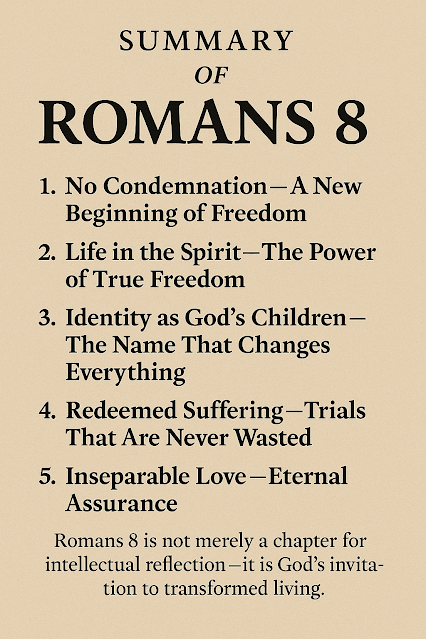
Romans 8 declares five core principles of Christian life—No Condemnation, Life in the Spirit, Identity as God’s Children, Redeemed Suffering, and Inseparable Love . Through C. S. Lewis’s insights, and Scripture, this message shows how these truths operate powerfully in our daily walk. It doesn’t end in understanding but invites us into a lived transformation. 1. No Condemnation – A New Beginning of Freedom “Therefore, there is now no condemnation for those who are in Christ Jesus” (Romans 8:1). This is not just a statement but a triumphant shout of the gospel that God has broken the chains of guilt. Many live under the burden of past sins and failures, but God has set us free. Paul does not present the absence of condemnation as a mere doctrine, but as a life-transforming reality. Because of Christ’s sacrifice, the penalty we deserved has been paid. Guilt no longer defines us—grace gives us our new name. C.S. Lewis once wrote, “The real challenge of Christian faith...

Overcoming 5 Hidden Obstacles to Prayer – C.S. Lewis Insights

Image
Drawing from C. S. Lewis’s insights, this message addresses five key obstacles— Pride ,  Doubt ,  Fear ,  Distraction , and  Self‑sufficiency —that weaken prayer and hinder intimacy with God, illustrated through Scripture verses, and Lewis’s quotations.  As we learn to recognize and overcome these barriers, prayer is restored as a living, powerful means for transformation and communion with God. 1. Pride – The Invisible Enemy in Prayer C. S. Lewis once stated, “Pride is the greatest sin and is completely opposed to God.”  This powerful declaration reveals how destructive pride can be—especially in prayer. Pride is subtle.  It masquerades as confidence, strength, and control, quietly infiltrating our hearts and altering how we relate to God. Often, we mistakenly think we are spiritually strong, yet this "silent poison" may actually be distancing us from Him. God does not desire eloquent words—He desires a humble and contrite heart fully surrendered. ...

The World of C.S. Lewis

Image
Clive Staples Lewis (1898–1963) A British literary scholar, Christian apologist, and fantasy writer. C. S. Lewis was “a man who understood God with reason and felt Him with imagination.” Once an atheist in his youth, he journeyed through war and suffering, philosophy and literature, ultimately arriving at faith. He became one of the greatest thinkers and storytellers of the 20th century, building bridges between reason and belief, pain and hope, reality and fantasy. Childhood and the Beginning of Imagination He came from a cultured middle-class family. His father, Albert, was a solicitor, and his mother, Florence, an educated woman, taught Lewis both mathematics and literature.  From early childhood, Lewis was a boy rich in imagination. Together with his older brother Warren, he created an imaginary kingdom called “Boxen,” inventing stories and drawing maps for it.  However, in 1908, at the young age of nine, he suffered a great loss when his mother died of peritonitis. A...